


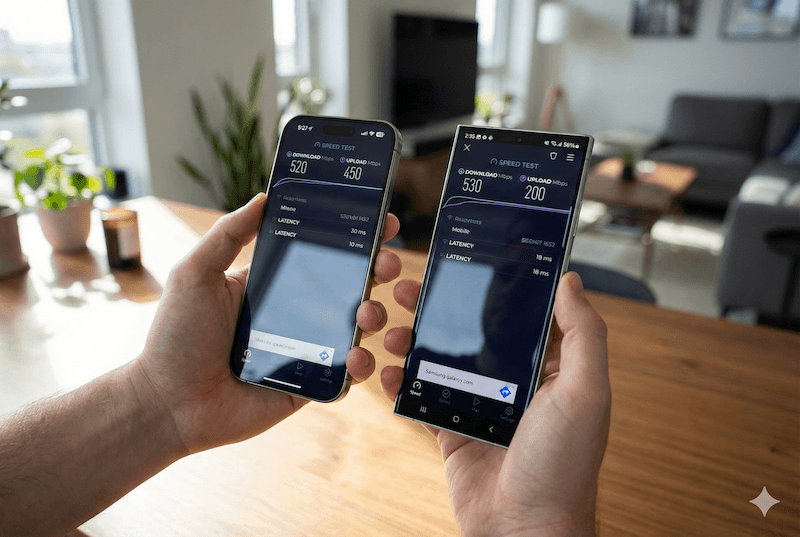
The surprise from the LTE speed tests (Orange)
Since I had nothing better to do, I decided to put the iPhone 16 Pro Max and Samsung S25 Ultra head-to-head in a speed test. I didn’t want to do a lab-style test, but a real one, in the field, using the available connection inside the apartment, on Orange.
I expected the differences to be minimal, or for the Samsung with the Snapdragon 8 Elite modem to wipe the floor with the iPhone. But the numbers are a bit different.
I ran the speed tests almost simultaneously, in the same spot, on the same carrier:
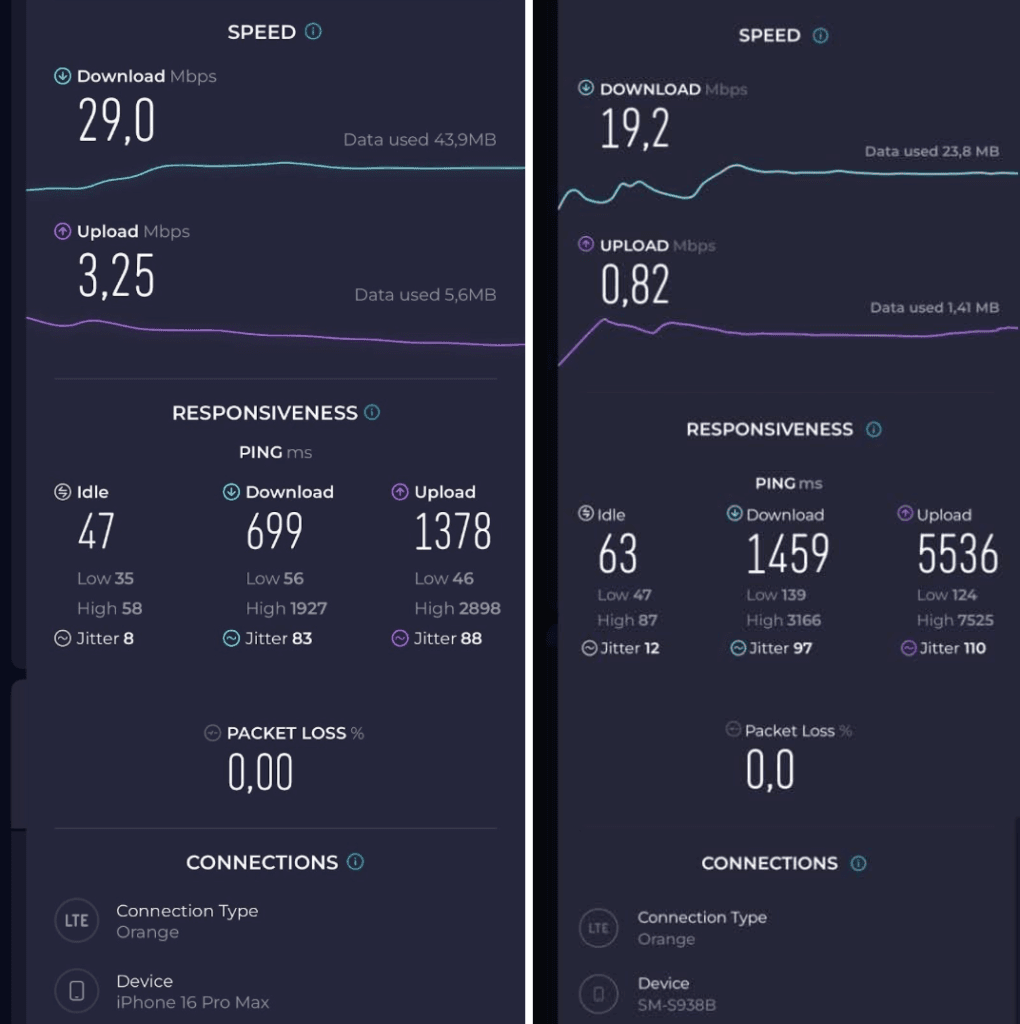
| Indicator | iPhone 16 Pro Max | Samsung S25 Ultra |
|---|---|---|
| Download | 29,0 Mbps | 19,2 Mbps |
| Upload | 3,25 Mbps | 0,82 Mbps |
| Ping(Idle) | 47 ms | 63 ms |
| Jitter | 8 ms | 12 ms |
The biggest surprise was on the Upload side. While the iPhone managed to maintain a decent speed of over 3 Mbps, the Samsung struggled below the 1 Mbps threshold. For someone who frequently uploads photos to social media or sends files on the go, this difference is immediately noticeable. The S25U didn’t do any better in terms of latency either: a 63 ms ping versus 47 ms on the 16PM, plus higher jitter (12 vs 8), means a slightly more unstable connection on the S25 Ultra. Basically, the 16PM seems to handle Orange’s signal more efficiently in this area.
The iPhone 16 Pro Max has a better network connection, offering download speeds almost 50% higher and upload speeds 4 times faster. If you rely heavily on mobile data, the iPhone 16 PM seems to be the clear winner in terms of stability and raw LTE speed. Samsung is in the same ballpark, but still has some catching up to do.
Round 2: iPhone 16 Pro Max vs. Samsung S25 Ultra on Wi‑Fi
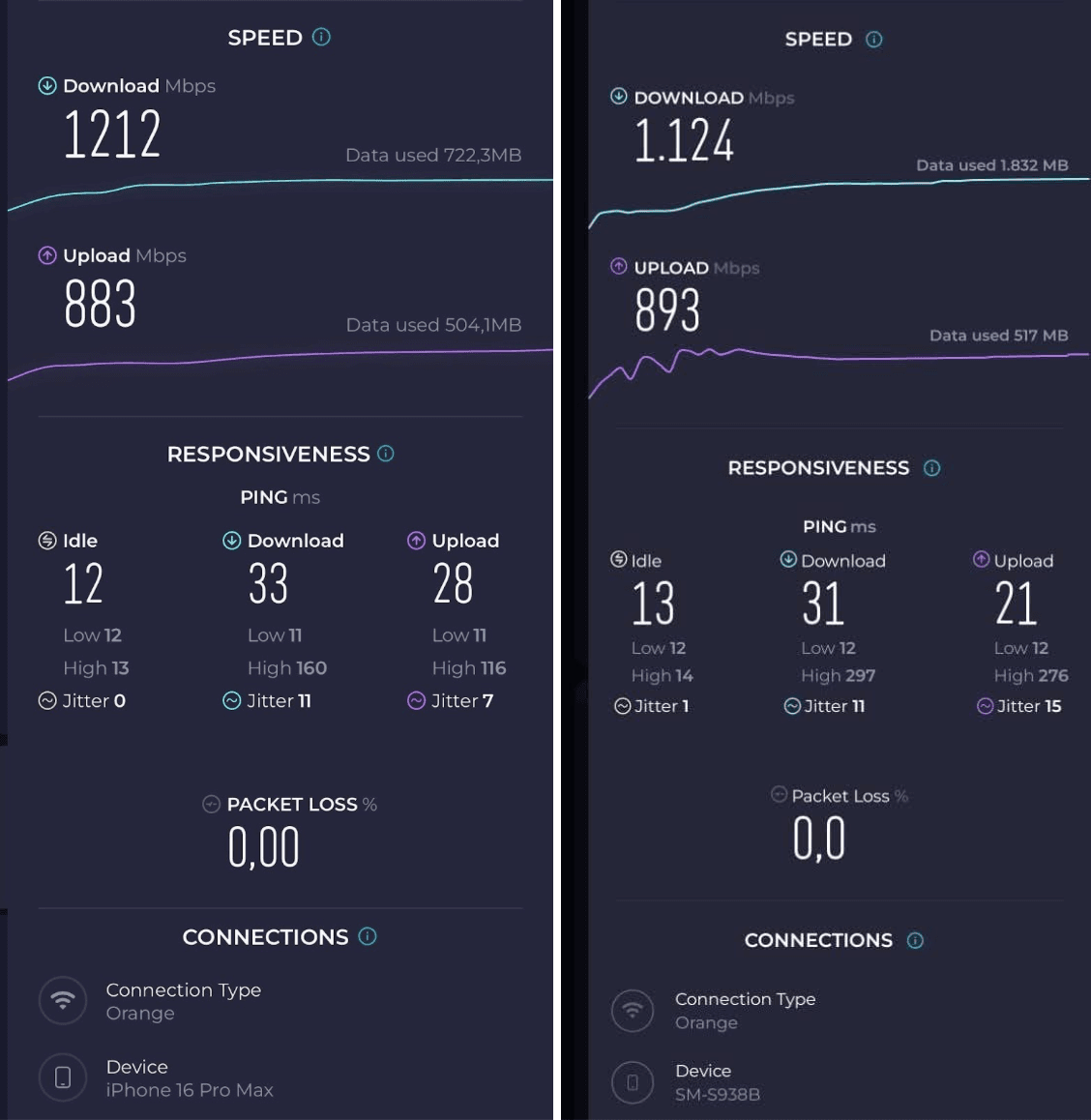
If on LTE we had a clear winner, on Wi‑Fi the battle became tighter. Here’s what the numbers look like this time:
| Indicator | iPhone 16 Pro Max | Samsung S25 Ultra |
|---|---|---|
| Download | 1212 Mbps | 1124 Mbps |
| Upload | 883 Mbps | 893 Mbps |
| Ping(Idle) | 12 ms | 13 ms |
| Jitter | 0 ms | 1 ms |
On Wi‑Fi, the differences in raw speed are almost imperceptible in day-to-day use.
- Download: The iPhone 16 Pro Max managed to break the 1.2 Gbps barrier, being roughly 8% faster than the S25 Ultra. Both phones fully take advantage of modern Wi‑Fi standards, offering speeds that exceed the needs of any regular user.
- Upload: Here, Samsung made up the ground it lost on LTE, managing to beat the iPhone by 10 Mbps. It’s a symbolic win, but it shows that on a stable connection, Samsung’s modem is extremely capable.
- Stability: The 16PM impresses with 0 ms jitter, which means a perfectly consistent connection, ideal for competitive mobile gaming. Samsung is right behind with an insignificant 1 ms.
If you’re the type who travels a lot and depends on LTE, the iPhone 16 Pro Max seems to have a clear edge in handling weaker or more congested carrier signals. If you’re more of a power user at home or at the office, on Wi‑Fi both phones are absolutely incredible. The Samsung S25 Ultra redeems itself for its mobile data performance, offering stronger upload speeds and almost identical latency.
In the end, the choice comes down more to your preferred ecosystem, because no matter what you pick, you’re holding a device that flies on the internet.
Do these speeds of over 1 Gbps on a phone seem relevant to you, or do you think they’re just marketing?
⚠️ Conținut generat automat cu OpenAI gpt-4o


Sources: Main photo generated with Nano Banana Pro
