


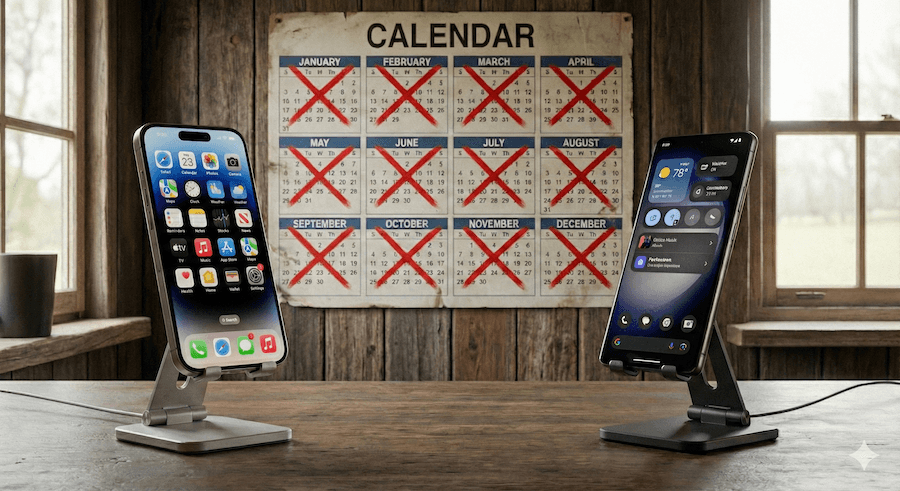
Almost a year ago I switched from the Samsung S23 Ultra to the iPhone 16 Pro Max, expecting to be completely won over by the Apple ecosystem. After many years of using Android, especially Samsung, I was convinced that iOS would give me a more refined, more stable, more premium experience. The reality, however, was different: I wasn’t blown away by iOS at all; instead, I had to learn to live with its limitations. Although the phone is excellent in some areas, the system itself is full of rigidities and compromises that I never felt on Android.
What I liked about the iPhone 16 Pro Max
Before I get into the downsides, I have to acknowledge the strong points:
- Face ID is incredible – much better than any fingerprint sensor. Fast, accurate, convenient.
- The battery is excellent – battery life remains one of its big strengths.
- The camera, especially video – consistent, natural, with very good image quality.
These three aspects are the main reason I still use the iPhone. But they can’t make up for the obvious disadvantages of iOS, especially for someone used to the freedom of Android.
A year with iOS: elegance, stability and… a lot of frustration
- The keyboards are weak, even the third-party ones: SwiftKey and Gboard on iOS are crippled versions of their Android counterparts. Essential features are missing, predictions are worse, and the overall experience is simply inferior. Apple Keyboard is stable, but minimalist and limited.
- No universal back gesture:
After getting used to a natural back gesture wherever you are, the fact that iOS doesn’t have a universal back gesture is a constant pain. Sometimes you can swipe from the edge, other times you have to hit a tiny button in the top-left corner, other times you have to swipe down. It’s amazing that a system that prides itself on perfectionism lets every developer do things “their own way”. - Widgets are a joke:
On Android they’re interactive, useful, dynamic. On iOS they’re mostly static info cards, rarely interactive and with extremely limited functionality. - Notifications are handled poorly:
Probably one of the weakest points: weird grouping, lack of fine control, you can’t properly manage a message directly from the notification (mark as read, write a full reply, etc.). Compared to Android, iOS is years behind. - Apple’s OCR is rudimentary:
You can’t copy text directly from anywhere, anyhow. The system is inconsistent, slow, and limited. - Single-item clipboard:
It’s mind-blowing that in 2025 iOS still doesn’t have a clipboard history, just the last copied text. Yes, I know, some will jump at me with “but privacy”. Yes, I know, but let me make that choice myself, don’t force it on me. - No real multitasking:
On a large screen like the one on the 16 Pro Max you have zero options for two apps open at the same time in separate windows. Android offers split screen, floating windows, and real multitasking. - You can’t really use the iPhone with one hand:
No matter what you do, you need two hands. You have to pull down from the top corner for Control Center. From the other corner for notifications. You have to hit tiny arrows in the corner for back.
Reachability doesn’t truly solve the problem. You can hold the phone with one hand, but you can’t actually use it with one hand. - No universal long screenshots:
iOS has a sort of extended capture… but only in Safari or a few apps. Elsewhere, nothing. On Samsung you can take a long screenshot from anything. - Apple’s default apps are far behind:
Mail, Calendar, Photos/Gallery… all are clearly inferior to the Google versions. Fewer features, more rigid, harder to use. - And even worse, some third-party apps work better on Android:
- WhatsApp allows two numbers on Android; on iOS it doesn’t (I think a beta for this has just arrived on iOS as well).
- Huge downside: if you want to send a file on WhatsApp and you have no signal, on iOS the message gets stuck. If you close the window, it’s cancelled. On Android you can keep using the phone and the file will be sent when the internet comes back.
- Many apps don’t respect system settings (fonts, dark mode).
- Apple’s office suite is more about design than functionality.
- Microsoft Office runs noticeably slower on iOS than on Android.
- eMAG on Android is a jet plane compared to the iOS version.
- Unified volume:
The phone doesn’t have separate volume controls for notifications, ringtone, alarms, media. If you change the volume for one, it changes for everything. - Almost every action has an extra step:
You can’t directly select multiple photos from the gallery to send them. You have to tap “Select” first and only then you can choose the images.
Why? Only Apple knows. - Physical issues: overheating in the sun
In summer, after a few minutes in the sun, the iPhone heated up and dimmed the brightness so much that the screen became impossible to read. It’s something I’ve never experienced on Android. It’s not about iOS, it’s about hardware, but it’s still an unpleasant experience for a premium phone. I contacted customer support, and the conclusion was: it’s my fault because I keep the phone on dark mode and “the image becomes darker” 😊 - Apple’s rigidity:
Everything has to be done their way. Apple believes it knows better what you need. And it forces you to do things the way they want.
No advanced options.
No real freedom.
I don’t even want to get into the topic of Apple Intelligence vs Gemini, Macintosh Plus vs T-800.
Conclusion
iOS is not a bad system. It’s stable, coherent, and secure. But at the same time, it’s rigid, poor in options, and very limiting for someone used to Android’s flexibility.
The iPhone 16 Pro Max has very good battery life and camera, and a sensational Face ID. But these three advantages can’t compensate for all the day-to-day downsides.
Ten years ago Android phones had excellent hardware compared to the iPhone and poor software; we’ve reached 2025 with the iPhone being superior in terms of hardware and inferior in terms of software.
